MERCOSUR Residence Agreement in South America: Requirements, Benefits and Migration Strategy
The MERCOSUR Residence Agreement offers citizens of several South American countries a simplified way to obtain legal residence, work authorization, and long-term stability in another country of the region. For many applicants, it is not only a practical migration option within South America, but also part of a broader strategy that may later lead to permanent residence, citizenship, and future migration opportunities toward Spain and Europe.
I. What Is the MERCOSUR Residence Agreement?
The MERCOSUR Residence Agreement is a regional mechanism that allows nationals of MERCOSUR Member States and certain associated states to apply for legal temporary residence and, later, permanent residence in another country covered by the agreement, under a simplified regime.
Its purpose is to facilitate regional mobility, promote South American integration and give nationals of the participating countries easier access to residence, work and regular life in another country of the bloc.
In practice, this agreement removes many traditional immigration barriers. The applicant does not need to justify a complex immigration basis, such as an investment, a prior employment contract or sponsorship by a company. The central element of the system is the applicant’s nationality.
In addition, the benefit may also have effects for the family group. A spouse may apply in their own right if they hold a nationality covered by the agreement, and minor children may be included or regularized later under the rules of family unity or family reunification, as applicable.
You can consult the official text of the agreement on the MERCOSUR website: https://www.mercosur.int/estatuto-de-la-ciudadania/circulacion-de-personas
II. Who Is Eligible?
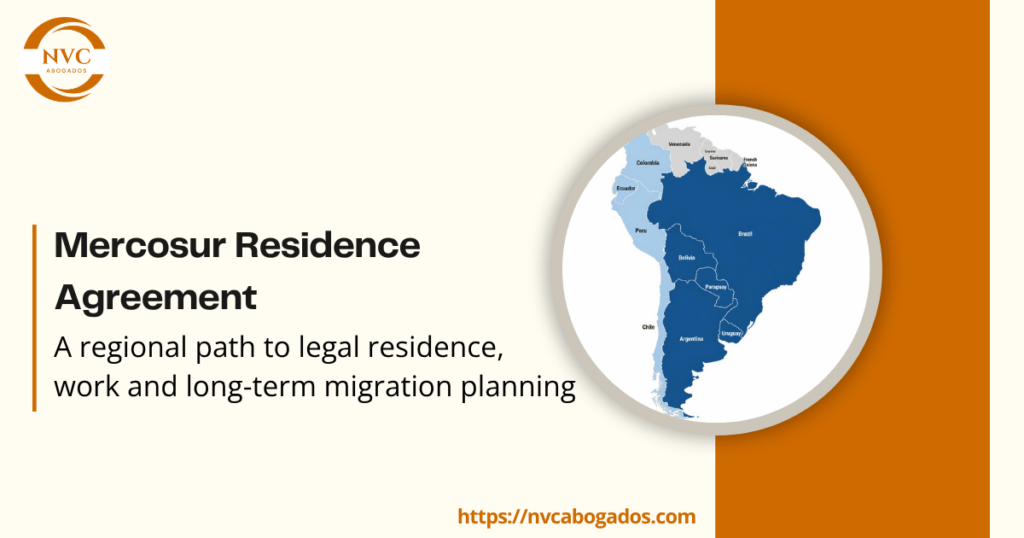
This regime is intended for nationals of the countries that form part of the MERCOSUR residence system, either as MERCOSUR Member States or as associated states that have joined the agreement.
Countries covered
MERCOSUR Member States
Argentina
Brazil
Paraguay
Uruguay
Bolivia
Bolivia acquired the status of MERCOSUR Member State in 2024. However, since its incorporation into the bloc is being implemented progressively, it is advisable to review the current rules of the country where the application will be filed.
Associated states covered by the residence system
Chile
Peru
Colombia
Ecuador
In practice, this mechanism covers a very significant part of South America for regional mobility purposes, with the exception of Venezuela in the framework discussed in this article.
Important Legal Clarification
This benefit is not available to every foreign resident in South America. It is available only to applicants who can prove that they are nationals of one of the countries covered by the agreement.
Therefore:
- It applies to Peruvian, Argentine, Colombian, Chilean, Bolivian citizens, among others.
- It does not apply to a foreign national living in Peru, Colombia, Argentina or another country in the region if that person does not hold the nationality of one of the countries covered by the agreement.
III. Main Benefits of the Agreement
1. Immigration Benefit
The main benefit is that a citizen of one of the covered countries can apply for residence in another country within the system through a simplified procedure.
In most cases, the applicant first obtains temporary residence. Later, before it expires, the applicant may request permanent residence. If the temporary residence is granted for two years, the permanent residence application can usually be filed during the 90 days before its expiration, that is, after approximately one year and nine months of residence.
A very important point for obtaining permanent residence is proving means of support. In practice, this means showing regular income from a local source, either as an employee or as an independent worker. The law does not necessarily establish a fixed minimum amount, but there must be regular income, especially because this type of residence is intended for people who will live and work in the receiving country.
2. Work Benefit
Residence obtained under the agreement generally allows the holder to:
- Work legally
- Carry out dependent or independent work activities.
- Develop commercial activities
- Access the formal labor system of the destination country under conditions similar to those of a local citizen, without being subject to the quotas or limits that may apply to foreign workers.
In other words, a separate work visa is not required once residence has been obtained under this agreement. However, if the person works as an employee, they must sign the corresponding employment contract and comply with any approval or registration requirements before the Ministry of Labor or regional authorities, depending on the place of residence.
3. Additional Benefits
Residence under this agreement may also allow:
- Access to public services
- Access to the financial system
- The possibility of regularizing family members
- Greater regional immigration stability
- A legal basis for future naturalization.
IV. Entry Into the Destination Country: Passport or National Identity Document
Within South America, many countries allow nationals of other countries covered by the agreement to enter with a valid passport or, in certain cases, with a national identity document that is recognized for regional travel.
Even when entry is possible with a national identity document, the immigration authority may later require additional documentation to prove identity and nationality during the residence process. For this reason, in practice, it is always advisable to also have a valid passport, especially if the applicant intends to start an immigration procedure.
There may also be practical limitations before residence is obtained. For example, some banks allow foreigners without residence to open an account, but they usually require a passport and, in some cases, a permit to sign contracts. Having these documents can make basic steps easier during the process, such as opening a bank account or signing a rental agreement.
V. Correct Time to File the Application
This is one of the most important aspects of the process and has significant practical consequences.
The application must be filed before the authorized period of stay as a tourist expires. In Peru, this period can be verified on the Migraciones website, where it is also possible to download the Virtual Andean Migration Card in PDF format.
You can verify the expiration date of your authorized stay here:
https://cel.migraciones.gob.pe/ConsultaTAMVirtual/VerificarTAM
Please note that, in most cases, you will receive 90 days from your arrival in Peru. At present, immigration control no longer places a physical tourist visa stamp in the passport. For this reason, we recommend checking and downloading the digital record of your entry and authorized stay.
When a foreign national enters the destination country as a tourist, the residence application must be filed before the authorized period of stay as a tourist or visitor expires.
Why is this so important?
If the person allows their authorized stay to expire:
- They may fall into irregular immigration status and lose the possibility of applying without first leaving the country and re-entering. In the case of nationals of the MERCOSUR area, there may be a maximum tourist stay of 180 days per year, but the initial 90 days are not renewable without leaving the country.
- They may incur fines or penalties for overstaying.
- The process may become more complicated or delayed.
- It may even affect the approval of the residence application, depending on the internal rules of each country.
The practical rule is clear: the MERCOSUR residence application should be prepared and filed before the authorized tourist stay expires.
This requires organizing the documents in advance, especially those issued in the country of origin.
VI. Documents From the Country of Origin
To apply for residence under the MERCOSUR Agreement, it is usually necessary to submit a series of documents obtained in the applicant’s country of origin or country of nationality.
Most Important Documents From the Country of Origin
1. Identity Document or Passport
The applicant’s identity and nationality must be proven with:
- A valid passport, or
- A national identity document.
2. Birth Certificate
The birth certificate must not have been issued more than six months before submission and must be apostilled.
It is a fundamental document to prove:
- Civil identity
- Parentage
- Full name
- Place and date of birth.
This document is often especially important in later procedures, such as permanent residence, citizenship or civil registry matters.
3. Civil Status Certificate
Depending on the case, the applicant must submit:
- Certificate of single status
- Marriage certificate
- Divorce judgment or divorce certificate
- Death certificate of the spouse, if applicable.
This document is important because many immigration and civil authorities require verification of the applicant’s actual family status. In addition, the civil status is indicated on the residence document.
4. Criminal Record Certificate From the Country of Origin
This document must show that the person has no convictions or relevant criminal records in their country of nationality or origin.
It is one of the most sensitive requirements in the immigration file and must bear the legalization under the Hague Convention, internationally known as the apostille. Today, in some countries such as Argentina, it is possible to obtain the digital apostille online through the remote procedures portal, as well as to request the criminal record certificate from RENAPER remotely.
General Rule
The documents must be:
- Apostilled, if the issuing country is part of the Hague Convention, or
- Legalized through the consular process, if the issuing country is not part of that convention.
Consequence of Not Complying With This Formality
If the foreign document is not properly apostilled or legalized:
- It may be rejected
- It loses evidentiary value
- It will not be valid for the immigration procedure.
Professional Recommendation
The file should be prepared before the trip or immediately after arrival, to avoid the tourist stay expiring before the documents are ready. This should always be done before starting the immigration process, because if the documentation is incomplete, the file may be formally observed and the applicant will receive a notice granting a period of five (5) days to correct the issue, which is usually impossible in practical terms.
In that case, we suggest requesting an extension as soon as the notice is received. If approved, this may allow up to 30 days to complete the documentation.
VII. Documents From the Country of Residence or Destination
In addition to the documents issued in the country of origin, the country where residence is requested usually requires locally issued documents.
Using a procedure in Peru as an example, while following a structure that may also apply in other countries of the region, the following documents are usually required.
1. Immigration Entry Record
The applicant must prove regular entry into the destination country and also show that their authorized stay is still valid through the Virtual Andean Migration Card mentioned above.
2. Immigration Application Form
Each country has its own form or administrative procedure. In Peru, the form must be completed for the change of immigration status from tourist to temporary resident under the MERCOSUR Agreement.
3. Proof of Payment of Administrative Fees
The procedure usually requires payment of an administrative fee.
In Peru, the corresponding payment code is 07568. This payment can be made at Banco de la Nación or through its app, known as Págalo.pe.
4. Background Certificates From the Country of Residence
In many cases, the applicant must also prove that they have no records in the country where the application is being filed.
For example, in Peru, the following certificates are required:
- Police Background Certificate
- Criminal Record Certificate
- Judicial Background Certificate.
5. Local Address or Place of Residence
The authority may require a declared address in the receiving country or proof of place of residence.
6. Photographs, Copies and Additional Documentation
The documents must be scanned in PDF format and submitted digitally through the website of the Digital Agency of the National Superintendence of Migration of Peru for evaluation within the legal period of thirty (30) business days.
After the application is filed, the system will generate a case number, as well as a username and password. These details must be downloaded and printed in order to follow up on the case. This is very important.
VIII. Structure of the Procedure: Temporary and Permanent Residence
1. Temporary Residence
In general, the applicant first receives temporary residence, often for up to two (2) years.
This residence allows the person to remain legally in the receiving country, work as an employee or independent worker, carry out economic activities and begin building the necessary ties for a future permanent residence application. The relevant period for applying for permanent residence also starts from this moment.
2. Conversion to Permanent Residence
Permanent residence must be requested before the temporary residence expires.
The applicant should not wait until the immigration status has already expired. This is a common mistake, together with the failure to prove income. For this procedure, the immigration authority may request documents showing means of support, such as receipts for professional services, sales receipts, invoices, bank accounts, employment certificates, income tax returns and bank statements showing the payments received.
If these documents do not exist or cannot be properly proven, the immigration process may be rejected.
For this reason, it is important to mark this deadline and not let it pass. After approximately one year and nine months of temporary residence, the applicant should evaluate starting the permanent residence procedure. This is a new immigration process, for which updated documents and proof of income will again be required.
IX. Citizenship in MERCOSUR and Andean Community Countries
Residence obtained through the MERCOSUR Agreement can also serve as the basis for a long-term strategy within South America. After a period of legal and effective residence, some countries allow foreign nationals to apply for citizenship, provided they meet the requirements established by local law.
In this context, the Andean Community should also be taken into account. The Andean Community, also known as CAN, is a regional bloc made up of Bolivia, Colombia, Ecuador and Peru. It promotes certain mechanisms of integration, mobility and cooperation among its member countries.
Obtaining citizenship in a South American country may not only consolidate a person’s immigration status in that country. It may also facilitate regional mobility and open new residence options in other MERCOSUR or Andean Community countries. For example, a person who acquires Peruvian citizenship could, in principle, later consider regional residence options in countries such as Brazil, Argentina, Chile, Colombia or Ecuador, depending on the current rules of the destination country.
For this reason, citizenship may form part of a broader immigration strategy, especially for people who wish to settle in South America, work legally in the region or keep several future residence options open.
Approximate Timeframes for Access to Citizenship
| Country | Approximate minimum legal period | Practical note |
|---|---|---|
| Argentina | 2 years | One of the fastest systems. |
| Peru | 4 or 5 years under the new Citizenship Law No. 32421 | Highly competitive if the person already resides in the country. |
| Paraguay | 3 years | Often used in immigration planning. |
| Ecuador | 3 years | A viable alternative. |
| Bolivia | 3 years | Less commonly used in practice. |
| Brazil | 4 years | May be reduced in certain cases. |
| Uruguay | 3 to 5 years | Requires stronger ties to the country. |
| Chile | 5 years | More demanding. |
| Colombia | 5 years | A longer procedure. |
Common Requirements for Citizenship
They usually include:
- Prior legal residence
- Real and effective presence in the country
- Good conduct
- Lawful and formal means of support, proven through tax or employment documentation
- Apostilled birth certificate
- Civil status certificate
- Criminal record certificate from the country of origin and local background records
- Proof of address.
X. Strategy Toward Spain
South American citizenship may also become part of a later immigration strategy toward Spain. This is because Spanish law allows certain foreign nationals to apply for Spanish citizenship by residence after two (2) years of legal, continuous residence immediately preceding the application, in the case of nationals of Ibero-American countries and other specific cases recognized by Spanish law.
This reduced period may be relevant for nationals of countries such as Argentina, Bolivia, Brazil, Colombia, Chile, Ecuador, Paraguay, Peru, Uruguay, Venezuela and other Ibero-American countries.
However, it is important to understand the scope of this rule correctly. For Spain, it is not enough to live in South America, hold residence in a South American country, be married to a national of that country or have family or personal ties to the region. What matters is having a formally recognized, valid and documented nationality.
In other words, the person must be legally considered a national of a country covered by the applicable Spanish regime. If the South American nationality was acquired by naturalization, the specific case should be reviewed before basing an immigration strategy on Spain’s reduced two-year residence period.
Difference Between Residence, a Citizenship Procedure and Recognized Citizenship
| Concept | Meaning | Does it have legal effect? |
|---|---|---|
| Residence in South America | The person lives legally in a South American country but does not hold its nationality. | No, not by itself. |
| Potential nationality | There may be a possible right to apply for nationality, for example by descent, but it has not yet been granted. | No. |
| Nationality in process | The procedure has already been started, but there is not yet a favorable decision or final registration. | No. |
| Recognized and documented nationality | The nationality has already been granted, registered and can be proven with valid official documents. | Yes, provided it meets the criteria required by Spain. |
Elements That Should Be Verified
For a nationality to serve as part of a strategy toward Spain, it must be clearly proven. In practice, this means verifying that:
- The nationality has been formally granted by the competent authority.
- There is a registration in the civil registry or corresponding national registry.
- The person has valid documents, such as a national identity document and passport.
- The nationality is recognizable before third parties and can produce legal effects before foreign authorities.
Common Mistakes
One of the most common mistakes is believing that residence in a South American country is the same as nationality. It is not.
It is also not enough to have a family connection, a personal relationship, a marriage or a procedure in progress. As long as the nationality has not been granted, registered and documented, it should not be considered a sufficient basis for an immigration strategy toward Spain.
Therefore:
- A person born in Peru, Argentina, Colombia or another Ibero-American country may evaluate the reduced period if they meet the Spanish requirements.
- A person who acquired South American nationality by naturalization should have their specific case reviewed before assuming that they can rely on the two-year period.
- A foreign resident in South America who does not hold the nationality of a covered country cannot benefit from this rule merely by living in the region.
XI. Conclusion
The MERCOSUR Residence Agreement is an important tool for those who wish to establish themselves legally in another country of the region, work, carry out economic activities and build a more stable immigration basis in South America.
For the process to work correctly, it is essential to file the application before the authorized tourist stay expires and to prepare the documents from both the country of origin and the destination country in advance. Particular attention should be paid to the validity, apostille or legalization of documents such as the birth certificate, civil status certificate, criminal record certificate and identity documents.
Beyond temporary residence, this regime may form part of a long-term immigration strategy. In some cases, it can open the way to permanent residence, future South American citizenship and new regional or international mobility options, provided that the applicable legal requirements are met in each country.
Frequently Asked Questions About the MERCOSUR Residence Agreement
The MERCOSUR Residence Agreement is a regional mechanism that allows nationals of certain South American countries to apply for temporary residence and later permanent residence in another country covered by the agreement through a simplified procedure.
The agreement applies to nationals of MERCOSUR Member States and certain associated states covered by the residence system. These include countries such as Argentina, Brazil, Paraguay, Uruguay, Bolivia, Chile, Peru, Colombia and Ecuador.
Not necessarily. The benefit is based on nationality, not only on residence. A foreigner living in Peru can only apply under this agreement if they hold the nationality of one of the countries covered by the MERCOSUR residence system.
In general, no separate work visa is required once residence has been granted under the MERCOSUR Agreement. The residence usually allows the holder to work legally as an employee or independent worker, subject to any local registration or contract requirements.
The application should be filed before the authorized tourist stay expires. Waiting until the tourist period has expired can lead to irregular immigration status, fines, delays or even problems with the approval of the residence application.
Common documents include a valid passport or national identity document, birth certificate, civil status certificate and criminal record certificate. These documents usually need to be apostilled or legalized and must comply with the validity rules of the destination country.
Yes. In many cases, the applicant first receives temporary residence, often for up to two years. Before it expires, the applicant may request permanent residence, usually by submitting updated documents and proof of regular income or means of support.
It can be part of a broader strategy, but residence alone is not enough. Spain’s reduced two-year residence period for citizenship applies to nationals of certain Ibero-American countries and other specific cases recognized by Spanish law. Therefore, the person must have a legally recognized and documented nationality, not merely residence in South America.

Do you need help with residence or citizenship planning in South America?
Moving within the region can raise important questions about immigration status, documents, deadlines and long-term options.
Book your private consultation with Sergio Vargas to review your situation and get clear guidance on the next legal and immigration steps.
The session takes place via Zoom and can be conducted in English or Spanish.
Don’t miss out on important updates!
Subscribe to our Substack newsletter and get the latest articles on immigration, taxes, and real estate in Peru delivered straight to your inbox.