1. Purpose and scope
This report explains the practical rules applicable to foreign citizens entering Peru as tourists or visitors. It covers verification of visa requirements before traveling, the digital entry record, monitoring the number of authorized days, the consequences of overstaying and the available payment methods when leaving the country.
The term “tourist visa” is frequently used to describe permission to travel. From a technical perspective, however, a distinction must be made between 1) a visa issued by a Peruvian consulate, 2) a visa exemption based on nationality and 3) the period of stay ultimately authorized by MIGRACIONES during immigration control at a Peruvian port of entry.
2. Which nationalities require a visa to enter Peru?
The official source is the chart published by the Peruvian Ministry of Foreign Affairs entitled Visa Requirements and Exemptions for Foreign Citizens Holding Ordinary Passports, updated in July 2026. Travelers must check the “Tourist” column: “Yes” indicates a visa exemption, while “No” means that the traveler must obtain a visa before traveling, unless a note or special regulation establishes an exception.
View the official chart of visa requirements and exemptions
When a visa is required, it must be obtained from a Peruvian consular office. The official procedure is available under Apply for a tourist visa to enter Peru. The documents and requirements submitted will be evaluated individually by the consular officer.
Warning. This information should be checked again before purchasing a ticket. Visa exemption agreements, lists of countries and airline requirements may change. In addition, a visa exemption does not, by itself, guarantee admission to Peruvian territory.
3. Special exception for citizens of China and India
Holders of ordinary passports issued by the People’s Republic of China and the Republic of India are listed in the official chart as being subject to mixed conditions. They normally require a visa, but may enter Peru without a temporary tourist or business visa if they can demonstrate that they meet at least one of the special conditions established under Peruvian law.
| Requirement | Chinese citizen | Indian citizen |
|---|---|---|
| Passport | Valid ordinary passport. | Valid ordinary passport. |
| Qualifying visa | A visa valid for at least 6 months issued by the United States, Canada, the United Kingdom, Australia or a Schengen Area country. | A visa valid for at least 6 months issued by the United States, Canada, the United Kingdom, Australia or a Schengen Area country. |
| Qualifying residence | Permanent residence in any of the specified territories. | Permanent residence in any of the specified territories. |
| Permitted activities | Tourism or business, according to the declared purpose of the visit. | Tourism or business, according to the declared purpose of the visit. |
| Reference period | Up to 180 non-extendable days; the actual period is determined by MIGRACIONES. | Up to 180 non-extendable days; the actual period is determined by MIGRACIONES. |
Source: Official chart published by the Peruvian Ministry of Foreign Affairs and updated on July 16, 2026; Supreme Decree No. 069-2016-RE and Supreme Decree No. 006-2017-RE.
3.1. What “residence in Europe” means
The exception does not refer to every type of European residence. The regulation requires permanent residence in a country belonging to the Schengen Area and also expressly includes the United Kingdom. Temporary residence, a student permit, a limited work permit or residence in a European country that does not belong to the Schengen Area should not be presumed sufficient.
3.2. Documents travelers should present
Valid ordinary passport. It must correspond to the Chinese or Indian nationality on which the traveler relies for the exception.
Qualifying foreign visa. It must be valid for at least six months. An expired visa does not meet this requirement.
Permanent residence card. It must clearly identify the issuing country, the holder’s permanent residence status and the document’s validity.
Evidence supporting the purpose of the trip. This may include an outbound ticket, accommodation details, proof of sufficient financial resources and a coherent explanation of the tourist or business purpose of the visit.
Important clarification. Temporary residence in the United States, Canada or Europe does not automatically qualify as “permanent residence.” If the document does not clearly establish permanent residence status, the traveler should request confirmation in advance from the competent Peruvian consulate.
Legal basis: Supreme Decree No. 069-2016-RE — People’s Republic of China; Supreme Decree No. 006-2017-RE — Republic of India.
4. Entry into Peru and the Virtual TAM
Since May 29, 2023, international airports in Peru have used the Virtual Andean Migration Card, known as the Virtual TAM, as the mechanism for recording entry and departure. The ordinary use of physical passport stamps has been suspended. The absence of a stamp in the passport is therefore normal, as the relevant record is stored in the MIGRACIONES system.
After each entry, visitors should access and save their record through the official Virtual TAM platform. The TAM allows travelers to verify the date of their most recent immigration movement and the number of authorized days of stay.
Important precaution. The Virtual TAM is not a visa. It is the electronic immigration record. Travelers should also not assume that each entry automatically grants 90 days. Nationality, the applicable visa exemption, previous visits and the decision made during immigration control may result in a shorter authorized stay.
5. Tourist overstay
An overstay occurs when a foreign citizen remains in Peru after the authorized period has expired. Beginning on the day after the authorized period expires, the traveler is considered to have irregular immigration status. This situation is not resolved merely by purchasing a ticket or paying a fine in advance. The traveler’s actual departure must be recorded.
5.1. Daily overstay fine in 2026
Article 190(a) of the Regulations of Legislative Decree No. 1350 establishes a fine equivalent to 0.1% of the UIT for each day of overstay when leaving the country. The 2026 tax unit, known as the UIT, is S/ 5,500. Therefore, the daily overstay fine in 2026 is S/ 5.50.
| Days of overstay | Calculation | Estimated fine in 2026 |
|---|---|---|
| 10 days | 10 × S/ 5.50 | S/ 55.00 |
| 18 days | 18 × S/ 5.50 | S/ 99.00 |
| 30 days | 30 × S/ 5.50 | S/ 165.00 |
| 90 days | 90 × S/ 5.50 | S/ 495.00 |
| 180 days | 180 × S/ 5.50 | S/ 990.00 |
This calculation is provided for reference. The final amount is determined by the MIGRACIONES system through the traveler’s actual departure date.
5.2. Additional consequences
Payment of the fine satisfies the financial obligation resulting from the overstay. However, it does not renew the traveler’s immigration status or retroactively legalize the period of irregular stay. MIGRACIONES has warned that irregular immigration situations may, depending on the circumstances and following the corresponding evaluation, result in fines, mandatory departure or expulsion.
6. Where and how to pay the fine
6.1. Payment before traveling
The safest option is to verify the number of days of overstay in advance and ask MIGRACIONES to calculate the amount due or identify the applicable payment code. When the code is available, the fine may be paid through the authorized channels of Banco de la Nación or through Págalo.pe. Travelers should not use an assumed payment code or pay an estimated amount without verifying that it corresponds to their identity document.
Official payment channel: Págalo.pe — Banco de la Nación (code 0675). The platform allows users to pay fees and fines imposed by different public entities, including MIGRACIONES, using the payment methods available at the time.
6.2. Payment at the airport or a land border checkpoint
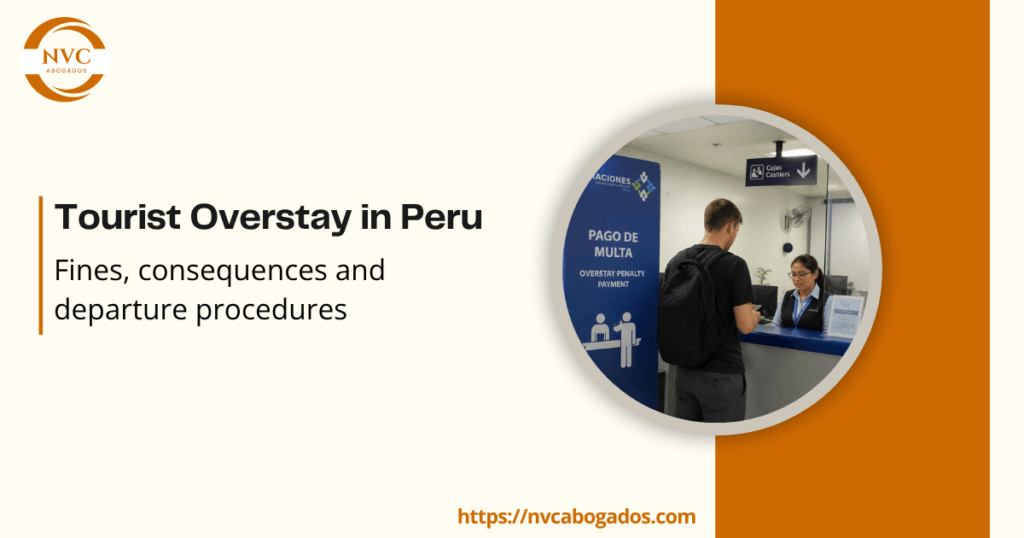
An overstay may be detected and the fine calculated during departure control at an international airport or a land border checkpoint. MIGRACIONES personnel will indicate the amount due and the authorized payment method available. After paying, the traveler must retain the receipt and return to immigration control to complete the departure record.
Operational recommendation. Travelers should not assume that every border checkpoint has a permanently available payment counter, internet connection, banking service or card payment facility. At an airport, travelers should arrive at least four hours before departure. Before leaving Peru by land, they should confirm the payment mechanism available at the selected border checkpoint.
Additionally: If you intend to become a legal resident of Peru, it is advisable to obtain your criminal record certificate online in your country of origin and then have it apostilled. Your next authorized stay may be shorter, so it is important to have the translation completed, obtain your Interpol certificate in Peru and prepare any additional documents required for the type of residence that best corresponds to your project or personal ties to the country.
7. Preventive protocol for tourists and visitors
Verify the visa requirement. Consult the official chart published by the Ministry of Foreign Affairs according to the traveler’s nationality and type of passport.
Review the exceptions. Chinese and Indian travelers should confirm the minimum remaining validity of their qualifying visa or their permanent residence status.
Download the TAM. Do so after each entry and confirm the number of days actually granted.
Set reminders. Schedule alerts for fifteen and seven days before the authorized stay expires.
Act before the deadline. Consider leaving the country or completing any legally available immigration procedure. Do not wait until your immigration status becomes irregular.
If an overstay has already occurred. Calculate the estimated amount, confirm the official assessment and pay through the channel indicated by MIGRACIONES.
Keep supporting documents. Retain the TAM, payment receipt, travel ticket and departure record.
8. Official sources and useful links
Ministry of Foreign Affairs: visa requirements and exemptions by country
Resolution No. 0119-2023-MIGRACIONES: suspension of physical passport stamps
Ministry of Economy and Finance: 2026 UIT established at S/ 5,500
MIGRACIONES: warning regarding fines and irregular immigration status
Legal notice: This report provides general and preventive information. It does not replace an individual analysis of the traveler’s nationality, travel document, immigration history, purpose of entry, foreign visa or residence status relied upon, and intended departure date.
Frequently Asked Questions About Tourist Overstay in Peru
You can check the number of days authorized by MIGRACIONES through the official Virtual TAM consultation portal. Enter the details of the travel document you used to enter Peru and verify your entry date, immigration checkpoint and authorized period of stay.
No. Tourists do not automatically receive 90 days each time they enter Peru. The authorized period depends on the traveler’s nationality, the applicable visa exemption, previous visits and the decision made by MIGRACIONES during entry control.
In 2026, the overstay fine is S/ 5.50 for each day beyond the authorized period. This amount corresponds to 0.1% of the 2026 UIT for every day of overstay. The final amount is calculated through the traveler’s actual departure date.
Yes. MIGRACIONES may calculate the fine during departure control at an international airport and indicate the available payment method. Travelers should arrive at least four hours before departure and keep the payment receipt to complete the exit procedure.
Yes. The safest option is to ask MIGRACIONES to confirm the number of days and the applicable payment code before traveling. When available, the fine may be paid through Banco de la Nación or Págalo.pe, generally using payment code 0675.
No. Paying the fine satisfies the financial obligation caused by the overstay, but it does not renew the traveler’s immigration status or retroactively legalize the irregular stay. The traveler’s departure must still be formally recorded.
Yes. Depending on the circumstances and the individual evaluation conducted by MIGRACIONES, irregular immigration status may result in a fine, mandatory departure or expulsion. Paying the fine does not prevent MIGRACIONES from evaluating other possible consequences.
Yes. Since May 29, 2023, Peru’s international airports have generally used the Virtual TAM instead of physical passport stamps. Travelers should download their Virtual TAM after entering Peru and verify the number of authorized days.

Need help choosing the right visa for Peru?
Immigration rules in Peru can be confusing – especially when it comes to the required documents, timelines, and legal steps. Choosing the right visa from the start can save you time, money, and stress.
Book your private consultation with Sergio Vargas to get expert guidance on the best visa option for your situation – and a clear plan to move forward.
The session takes place via Zoom and can be conducted in English or Spanish.
Don’t miss out on important updates!
Subscribe to our Substack newsletter and get the latest articles on immigration, taxes, and real estate in Peru delivered straight to your inbox.