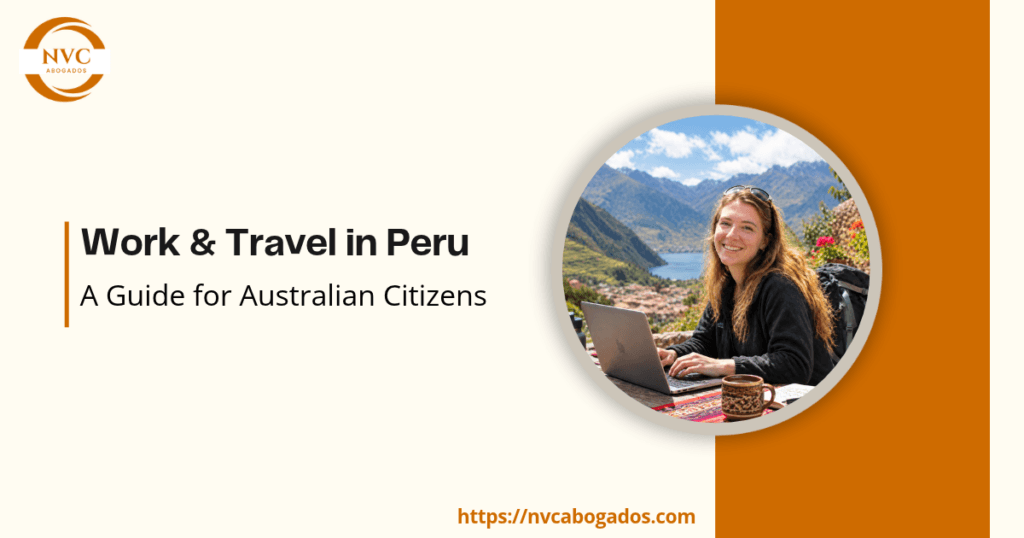
How to live, travel, study and work legally in Peru for a year
Australia and Peru may be geographically far apart, but an agreement between the two countries allows young Australians to spend up to twelve months in Peru, combining travel with study and temporary work.
Often described as Work & Travel, the program’s official name is Work and Holiday. It offers more than a tourist visa: you can work to help fund your stay, provided you follow the programme’s conditions.
The program was established under the Memorandum of Understanding on a Work and Holiday Program between Peru and Australia, signed in Canberra in May 2017. Its purpose is to encourage cultural exchange between young people from both countries and allow them to supplement their travel funds through temporary employment.
This article covers the procedure for Australian citizens who want to live temporarily in Peru. Peruvians wishing to travel to Australia must follow a separate application process under Australian requirements.
1. What is the Peru – Australia Work and Holiday visa?
For Australian citizens, the Work and Holiday visa allows a combination of holidays, cultural exchange, short-term study and temporary work in Peru.
According to the information published by the Peruvian Consulate General in Sydney, you can:
- Stay in Peru for up to twelve months.
- Leave and re-enter the country multiple times during that period.
- Work for up to six months with any one employer.
- Study for a maximum of four months.
It is an option for anyone who wants to experience everyday life in Peru beyond a conventional holiday.
2. Who can apply?
You must meet personal, educational, financial and documentary requirements.
Age: You must be between 18 and 30 when you apply. In other words, you must not have turned 31.
Nationality: You must hold a valid Australian passport.
Location when applying: You must be outside Peru when you submit your application.
You should therefore prepare your application before travelling. We do not recommend entering Peru as a tourist on the assumption that you can complete the same procedure from within the country.
3. Do I need to speak Spanish?
Yes. You must demonstrate a functional level of Spanish.
The Peruvian consular office may assess your language skills through an interview in person or by video call. If your Spanish is considered insufficient, your application may be refused.
This requirement reflects the programme’s purpose: to encourage cultural exchange and participation in working life in Peru.
4. What qualifications do I need?
You do not necessarily need to have completed a university degree. The consular information lists the following alternatives:
- Hold a university degree.
- Have successfully completed at least two years of university study and progressed to the third year.
- Hold a qualification from an officially recognised professional or technical programme lasting at least two years.
Before applying, check that your qualifications meet one of these conditions and gather the documents needed to prove it.
5. How much money do I need to show?
You must demonstrate that you have enough money to support yourself initially in Peru and pay for your departure.
The published consular information specifies:
- USD 2,500 for living expenses.
- An additional USD 1,800 for travel tickets, unless you already hold the relevant tickets.
You can demonstrate your financial means through bank documents or other evidence accepted by the consular office.
The purpose is to show that you can support yourself at the beginning of your stay without depending on finding work immediately after arrival.
6. Can I travel with dependent children?
The program is intended as an individual youth exchange experience and has specific eligibility requirements concerning dependent children.
The consular information requires a declaration on this point. If you have dependent children, check your eligibility before preparing an application. Do not assume that travelling without them is enough to meet the requirement.
The Work and Holiday visa is not a family residence route or a way to relocate to Peru with your family.
7. Which documents should I prepare in Australia?
Depending on your circumstances and the consular instructions applicable when you apply, you will need to prepare documents including:
- An Australian passport valid for at least eighteen months
- Evidence of your identity and date of birth
- Evidence of your university, professional or technical studies
- Proof of sufficient funds
- Evidence of good character
- Completed and signed consular forms
- Declarations required by the programme
- Evidence of your functional Spanish skills
- Medical and travel insurance
- Any additional Australian documentation required under the Memorandum of Understanding
Review your application documents before travelling. A document that is easy to obtain in Australia may be much harder to arrange once you are in Lima or travelling elsewhere in Peru.
8. Where do I apply for the visa?
The process begins before you travel to Peru.
You can apply through one of the Peruvian consular authorities in Australia, such as the Consular Section of the Peruvian Embassy in Canberra or the Peruvian Consulate General in Sydney, subject to their jurisdiction and application rules.
You must complete the visa application form and provide supporting documents showing that you meet the requirements.
The published consular fee for this category is USD 80. Before submitting your application, confirm the amount and payment instructions with the office handling it.
You can find the official programme information and access the DGC-005 visa application form on the following page:
9. What happens when my visa is approved?
Once approved, the visa is placed in your Australian passport.
You must use it within the entry deadline specified by the consular authority. The program’s twelve-month stay begins when you first enter Peru.
For example, if you first enter Peru on 1 September 2026, your authorised period is calculated from that date.
You can leave Peru and return during the program. However, time spent outside the country does not pause or restart the twelve-month period.
10. I have arrived in Peru. Is the process complete?
Not necessarily. Obtaining your visa in Australia is the first stage.
After entering Peru, you need to complete the documentation for your immigration status through the Peruvian Ministry of Foreign Affairs, also known as Cancillería.
In a recent case we assisted with, the Peruvian stage involved formalising and documenting the applicant’s Intercambio Residente status.
This step provides the documentation corresponding to your immigration status for the authorised period.
11. Who issues the resident’s identification document?
This category differs from ordinary immigration procedures handled by Peru’s National Superintendence of Migration, known as Migraciones. Under this programme, the Ministry of Foreign Affairs is directly involved.
Once the relevant procedure is complete, you receive the identification document associated with your immigration status.
This document is important for subsequent administrative, employment, tax and banking procedures in Peru.
12. Can I work legally in Peru?
Yes. One of the program’s main benefits is the opportunity to work during your authorised stay, subject to the agreement’s conditions.
A key restriction is that you cannot work for the same employer for more than six months.
During a twelve-month stay, for example, you could work for one company and then another, provided you comply with the applicable immigration and employment requirements.
The program’s main purpose remains holidays and cultural exchange. Work is a complementary activity that helps fund the experience.
13. What if I work as an employee of a Peruvian company?
Immigration permission to work and the formal requirements for employment are separate matters.
If you work under the direction and control of a Peruvian company, you are an employee. You must have an employment contract, and the company must comply with Peruvian rules for hiring foreign workers.
This requires reviewing the applicable contract procedure before the Ministry of Labour and Employment Promotion (MTPE) and, where relevant, through the Virtual System for Foreign Workers’ Contracts (SIVICE).
The official program information also states that Australian participants who obtain employment must inform the Ministry of Labour of their employment situation.
The employer must meet the applicable obligations concerning payroll, pay, social security and other employment benefits.
14. What if I work as a freelancer or independent professional?
Independent work differs from an employment relationship.
You might provide services independently as a programmer, designer, consultant, photographer, English teacher or marketing specialist, for example.
Where the work is genuinely independent, there is no employment contract to process as such before the Ministry of Labour. You must review whether the activity is compatible with your immigration authorisation and determine your obligations before SUNAT, Peru’s tax authority.
The actual working arrangement matters. Calling a role “freelance” does not remove employment obligations if, in practice, you work under an employer’s direction and control.
15. Freelancers: RUC registration and SUNAT
To carry out an independent professional activity, you need to review your registration in the Single Taxpayer Registry (Registro Único de Contribuyentes, or RUC) with SUNAT.
SUNAT provides for the registration of foreign nationals authorised to carry out income-generating activities, using the immigration or identification documents accepted for each situation.
Once you have obtained your Intercambio Residente documentation, you should establish the appropriate tax registration before regularly providing professional services.
Income from individually practising a profession, art, science or trade generally falls within fourth-category income under Peruvian tax rules. The specific treatment also depends on your tax circumstances.
The procedures and obligations to review include:
- Obtaining or activating your RUC.
- Registering the appropriate activity and tax obligations.
- Obtaining or accessing your Clave SOL online tax credentials.
- Issuing electronic professional fee receipts, known as recibos por honorarios electrónicos, where applicable.
- Complying with applicable income tax withholding, filing and payment obligations.
To issue electronic professional fee receipts, you must have the appropriate tax registration and access through Clave SOL.
The distinction between the two working arrangements can be summarised as follows:
Employee: an employment contract, employment obligations and any applicable MTPE or SIVICE formalities.
Freelancer or independent professional: review of RUC registration, SUNAT obligations, Clave SOL access and the appropriate payment documents.
Immigration authorisation and employment or tax obligations are related but separate issues. How you work determines the additional procedures you need to complete.
16. Can I work throughout the year?
You can work during your authorised stay, but you must respect the limit of six months with any one employer.
For example:
- First six months: employment with Company A.
- Following six months: employment with Company B.
This must remain consistent with the programme’s temporary nature and cultural purpose.
For independent activities, the specific arrangement must be assessed to confirm that the services are genuinely independent and do not amount to a disguised employment relationship.
17. Can I study in Peru?
Yes. The program allows you to study for a maximum of four months.
You could combine your stay with Spanish classes, short university programs or courses in gastronomy, history, archaeology, Peruvian culture or vocational subjects.
18. Can I leave Peru and return?
Yes. The program allows multiple entries and exits during your authorised stay.
You can therefore live temporarily in Peru while also visiting other South American countries.
Remember that travel abroad does not pause or restart the twelve-month period, which runs from your first entry into Peru.
19. A real case handled in Lima
In September 2026, we assisted an Australian citizen who had entered Peru under the Work and Holiday program and needed to complete the relevant stage before the Ministry of Foreign Affairs.
During the procedure, Cancillería formalised his Intercambio Residente status with a twelve-month validity period. The Ministry’s Directorate of Consular Procedures subsequently coordinated the delivery of his identification document in Lima.
This case illustrates why you should also prepare for the procedures after arrival. Obtaining the visa before travelling does not mean that all the documentation needed for your stay is already in place.
20. Can I stay permanently in Peru after the year ends?
Work and Holiday is a temporary program. It does not automatically grant permanent residence.
However, your circumstances may change during those twelve months. You might find a long-term professional opportunity, establish a company, start a family or decide that you want to continue living in Peru.
If that happens, you need to assess whether you qualify for another immigration status under Peruvian law.
You should plan before your current authorisation expires, so you have time to identify the available options and complete the necessary procedures.
An opportunity for Australians who want to live in Peru
The Work and Holiday program allows you to spend up to twelve months in Peru, undertake complementary work, study for up to four months and leave and re-enter the country multiple times.
It gives you time to explore Peru, improve your Spanish and experience everyday life before considering a longer stay.
To make the most of it, you need to prepare both your visa application abroad and the subsequent procedures before Cancillería. If you start working, you must also meet the obligations applicable to your activity.
If you are an employee, your employment relationship needs to be properly formalised. If you provide services independently, you need to review your tax registration and obligations before SUNAT.
With the paperwork organised, you can focus on the experience of living, travelling, studying and working legally in Peru.
How can we help?
At NVC Abogados, we advise you on the Peruvian stage of the Work and Holiday program and the immigration, employment and tax matters connected with your stay.
We can assist with:
- Reviewing your immigration documents.
- Completing the procedure before Cancillería after arrival.
- Obtaining documentation for your Intercambio Residente status.
- Formalising employment with a Peruvian employer.
- Tax registration and RUC procedures for independent professionals.
- Procedures for opening a bank account.
- Assessing other residence options if you decide to stay in Peru after the program ends.
Frequently Asked Questions about Work & Travel in Peru
Australian citizens aged 18 to 30 can apply for Peru’s Work and Holiday program. It allows a stay of up to twelve months, temporary work and up to four months of study. Applicants must meet the program’s educational, financial, Spanish-language and other requirements.
You must be outside Peru when you apply for the Peru–Australia Work and Holiday visa. If you plan to use this programme, arrange your application before travelling rather than assuming you can switch from tourist status after arrival.
A job offer is not listed among the program’s application requirements. You must, however, demonstrate sufficient funds to support yourself initially and cover your departure. Once you find employment, you and your employer must complete the applicable employment formalities.
You need functional Spanish, which the Peruvian consular office assesses through an interview. Knowing a few travel phrases does not necessarily meet this requirement. Your language skills must be sufficient to satisfy the consular assessment when you apply.
Yes. The program limits work with any one employer to six months. You can work for different employers during your authorised stay, provided each employment relationship complies with the applicable rules and your work remains consistent with the program’s purpose.
You need to complete the relevant documentation procedure with Peru’s Ministry of Foreign Affairs, known as Cancillería, for your Intercambio Residente status. If you plan to work, you must also address the employment or tax requirements applicable to your activity.
If you plan to provide independent professional services in Peru, you need to review your registration for a Peruvian tax number, known as a RUC, with SUNAT. Your obligations depend on your activity and tax circumstances and may include Clave SOL access, electronic professional fee receipts and tax filings.
No. The twelve-month period runs from your first entry into Peru under the program. You can leave and return during the authorised period, but trips abroad do not pause the clock or give you a new twelve-month stay.

Planning your Work & Travel experience in Peru?
We can help you navigate Peru’s Work and Holiday program, from reviewing your eligibility and documents to completing the procedures after arrival and understanding the requirements for working legally in Peru.
Book your private consultation with Sergio Vargas to discuss your plans and get advice tailored to your situation.
The session takes place via Zoom and can be conducted in English or Spanish.
Don’t miss out on important updates!
Subscribe to our Substack newsletter and get the latest articles on immigration, taxes, and real estate in Peru delivered straight to your inbox.