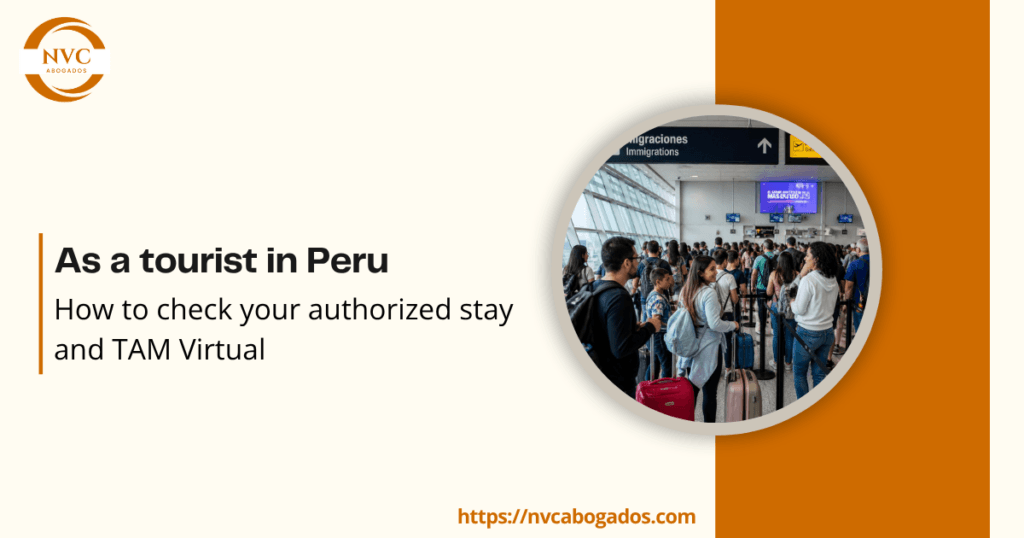
Peru no longer routinely places immigration stamps in passports at its international airports. However, the absence of a physical stamp does not mean that the entry has not been recorded. Immigration movements and authorized days are registered in the MIGRACIONES systems. For this reason, travelers should check their Virtual TAM immediately after each entry.
1. What changed in 2023?
Through Superintendency Resolution No. 0119-2023-MIGRACIONES, published on May 25, 2023, it was established that, as of May 29, 2023, immigration checkpoints at Peru’s international airports would use the Virtual Andean Migration Card, known as the Virtual TAM, to record entry into and departure from the country. As a result, the routine use of immigration stamps at these airports was suspended.
A stamp may only be used exceptionally as a contingency measure when a technical issue prevents the use of the Virtual TAM. Therefore, a passport without an entry stamp is now normal and does not, by itself, affect the legality of a person’s entry.
Legal clarification
The Virtual TAM is not a visa. It is the official electronic record of a person’s immigration movement. It allows travelers to verify their entry date and the period of stay authorized under the corresponding immigration status.
2. How to check and download your Virtual TAM
You can check your information through the official Virtual TAM Consultation portal provided by MIGRACIONES. Official guidance about the TAM is also available online.
- Enter your information. Provide the travel document used to enter Peru, your nationality and the other information requested by the system.
- Check the immigration movement. Confirm the entry date, the immigration checkpoint and the number of days granted.
- Download and save the document. Save the digital record as a PDF and keep an accessible copy on your phone or in your email account.
- Review any discrepancies. If the record does not appear or contains an error, request verification or correction from MIGRACIONES before beginning a procedure or approaching the expiration date.
Professional recommendation
Do not calculate your departure date based solely on your airline ticket, verbal information or the planned duration of your trip. The practical reference should be the period shown in the official immigration record.
3. The 90 days: a common reference, not an automatic renewal
Under many visa exemption and entry regimes, a tourist may receive up to 90 days of authorized stay. However, there is no universal rule under which every foreign national necessarily receives 90 days upon the first entry or another 90 days every time the person leaves and reenters Peru.
The specific period depends on several factors. These include the traveler’s nationality, the applicable visa or visa exemption regime, the cumulative limits established for a particular period, the history of entries and departures and the assessment made during immigration control.
The decisive information for the traveler is the number of days actually authorized and recorded by MIGRACIONES.
If you have already stayed in Peru during the relevant period
Days previously spent in Peru may be considered when calculating the remaining time available. For this reason, a short trip outside the country does not necessarily reset the calculation.
For example, if the applicable regime permits a cumulative maximum of 90 days and the person has already used 35 days, a new entry may be limited to the remaining 55 days, or to a shorter period, depending on the immigration control.
This example is only for guidance. Travelers must verify the rule applicable to their nationality and the Virtual TAM issued after each entry.
| Common assumption | Prudent approach |
|---|---|
| “There is no stamp, so there is no immigration control.” | The record is electronic and can be verified by MIGRACIONES. |
| “Every entry grants 90 days.” | The period may be shorter and depends on the applicable regime and the traveler’s immigration history. |
| “Leaving and reentering resets the period.” | Days previously spent in Peru may count toward the applicable cumulative limit. |
| “The TAM is my visa.” | The TAM records the immigration movement and the authorized number of days. It does not replace a visa when one is required. |
4. Risks of exceeding your authorized stay
Remaining in Peru after the authorized date places a foreign national in an irregular immigration situation. This may result in a fine calculated under the regulations in force, outstanding obligations when leaving the country, difficulties during future immigration controls and obstacles when beginning or completing certain immigration or notarial procedures.
MIGRACIONES recommends that visitors monitor their authorized stay and avoid exceeding it. Travelers should check their information sufficiently in advance to evaluate when they need to leave the country.
Under the rules in force as of August 20, 2026, a person must leave Peru and reenter the country to receive a new period of authorized stay. It is no longer possible to extend a tourist stay online before it expires, as was the case several years ago.
When legally possible, the person may also evaluate changing to an appropriate immigration status, provided that the applicable requirements are met. This is one of the main challenges we address in our daily work.
Practical warning
Download your Virtual TAM on the day you enter Peru or the following day. Set two reminders, one 15 days before the expiration date and another 7 days before it.
If the information does not match your travel plans, seek professional advice before signing contracts or beginning an immigration application.
5. A valid stay and signing documents in Peru
Maintaining a regular immigration status is particularly important when a tourist needs to carry out transactions with financial or property consequences. Although each transaction has its own requirements, these procedures usually require a document review and, in many cases, the involvement of a notary or public registry.
These transactions include:
- Purchasing or selling real estate or a vehicle
- Establishing a company or an NGO
- Signing a purchase agreement or public deed for real estate, a car or a motorcycle
- Granting a power of attorney in Peru
- Signing civil, commercial or employment contracts
- Opening a bank account, which is also subject to the identification, compliance and risk policies of each financial institution
6. Special permit to sign documents
A foreign national who is in Peru as a tourist and needs to enter into certain contracts should first verify whether a special permit to sign documents is required.
This permit allows a tourist to sign documents related to civil or commercial transactions during a temporary stay. It does not authorize the person to work and does not replace an immigration status that grants work authorization.
Information about the procedure, its requirements and access to the application is available on the official MIGRACIONES page: Apply for a special permit to sign documents.
The application should be planned while the authorized stay remains valid and before the documents are signed. An expired immigration status may prevent or complicate the procedure.
Important
The immigration permit does not replace the other requirements of the transaction. A notary, SUNARP, a municipality or a financial institution may require additional documents. Banks also retain the authority to approve or reject an application to open an account.
7. Preventive protocol for every visitor
- Before traveling: Verify whether your nationality requires a visa and determine the applicable limit on your stay
- After entering Peru: Check your Virtual TAM, confirm the number of days granted and save a copy of the record
- During your stay: Keep a cumulative record of all entries and departures during the relevant period
- Before signing a contract or completing a transaction: Confirm that your authorized stay remains valid and, when required, apply for the special permit to sign documents, as you will need it to formalize the contract
- Before the expiration date: Plan your departure or the permitted immigration procedure in good time. Do not assume that reentering Peru will automatically grant another 90 days
Conclusion
The digitalization of immigration control has simplified entry into Peru, but it has also given travelers a practical responsibility. They must check and retain their electronic immigration records.
Since 2023, the absence of a physical entry stamp has been standard practice at Peru’s international airports. The Virtual TAM is the official evidence of the traveler’s immigration movement and the period of stay granted.
The best preventive measure is to verify the record after each entry, never assume that 90 days have been granted automatically and take action before the authorized stay expires. This protects the legality of the stay, reduces the risk of fines and prevents a real estate, banking, corporate or notarial transaction from failing because of an immigration problem that could have been identified in time.
In our next article, we will explain the available solutions when a tourist exceeds the authorized period of stay in Peru, how to pay the fine before leaving the country and the possible immigration consequences.
Note: This article is provided for informational purposes only. It does not replace an individual assessment of the traveler’s nationality, immigration history, purpose of travel and the documents required for the planned transaction.
Frequently Asked Questions About Tourist Stays in Peru
You can check the number of days authorized by MIGRACIONES through the official Virtual TAM consultation portal. Enter the details of the travel document you used to enter Peru and verify your entry date, immigration checkpoint and authorized period of stay.
Peru stopped routinely stamping passports at its international airports in May 2023. Entries and departures are now recorded electronically through the Virtual Andean Migration Card, known as the Virtual TAM. A passport without an entry stamp does not mean that your entry was not registered.
No. The Virtual TAM is the official electronic record of your entry, departure and authorized period of stay in Peru. It does not replace a visa when a visa is required for your nationality.
No. The number of days granted depends on factors such as your nationality, the applicable visa or visa exemption rules, your previous entries and departures and the decision made during immigration control. Always check the number of days shown in your Virtual TAM after entering Peru.
No. A short trip outside Peru does not necessarily reset your authorized period of stay. Days previously spent in the country may count toward the cumulative limit applicable to your nationality, and MIGRACIONES may grant fewer than 90 days when you reenter.
Yes, but you may need to obtain a special permit from MIGRACIONES before signing certain civil or commercial documents. You must apply while your authorized stay is still valid. The permit does not authorize you to work and does not replace any additional legal, notarial or registration requirements.

Need help choosing the right visa for Peru?
Immigration rules in Peru can be confusing – especially when it comes to the required documents, timelines, and legal steps. Choosing the right visa from the start can save you time, money, and stress.
Book your private consultation with Sergio Vargas to get expert guidance on the best visa option for your situation – and a clear plan to move forward.
The session takes place via Zoom and can be conducted in English or Spanish.
Don’t miss out on important updates!
Subscribe to our Substack newsletter and get the latest articles on immigration, taxes, and real estate in Peru delivered straight to your inbox.