Some emotional reflections on immigration, interculturality and starting over, do you dare to try?
Moving to another country is never only an immigration procedure. It is not only about getting a visa, opening a bank account, renting an apartment or learning how to use another currency. That is merely the visible or material surface of the process, which is much deeper.
True immigration begins some time later, perhaps a few weeks or months later, when we begin to live “day by day”, when that initial enthusiasm that dazzled us begins to seem like part of the landscape or of our daily life, of our routine, and disappears when the photographs stop looking like postcards and novelty slowly turns into your everyday life. That is where you begin to live your migration process in your inner “self”.
That is where the true journey begins, or the new adventure you chose.
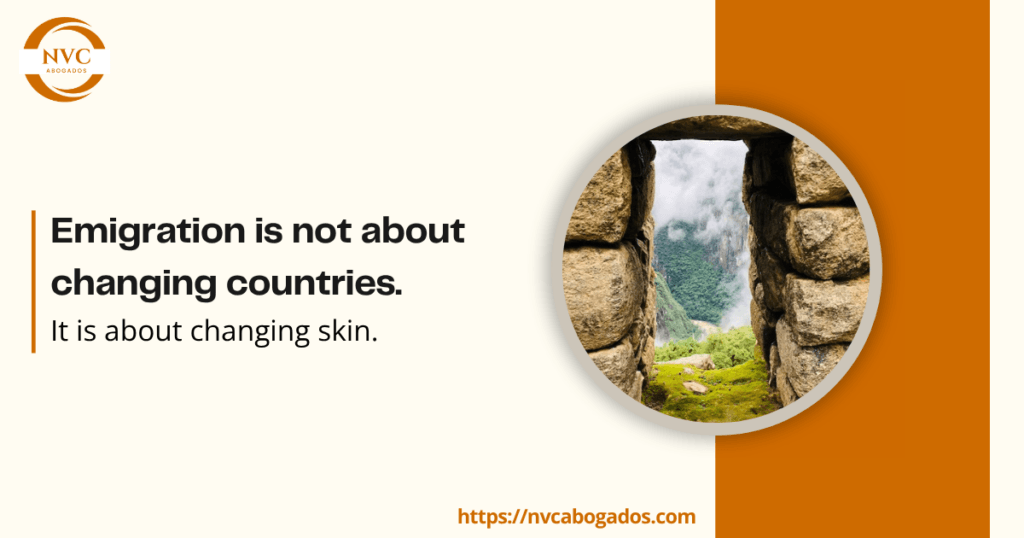
Because emigrating is not only crossing a geographical border. Above all, it is crossing an emotional border and, many times without realizing it, the immigrant ends up entering one of the deepest, loneliest experiences in connection with oneself, and also one of the most transformative experiences a person can live. This makes us strong, it makes us tolerant, if we manage to achieve the great challenge that I like to call “crossing the bridge”, the bridge of interculturality.
The day you discover that you are a foreigner
The day you discover that you are a foreigner
Many Europeans or North Americans and citizens from all over the world arrive in Peru or South America today with hope, curiosity and a romantic idea of change. About them, we can mention some of the most frequent comments I hear in my daily life when I talk with expatriate friends or clients who live in different cities of the country, such as:
- In Peru, there are almost no rules, I love that.
- In Peru, I am looking for a simpler but more human life.
- People here are much warmer.
- People are less structured.
- Yesterday I met some neighbors and they already invited me to dinner at their house the next day. Although I did not understand everything they were talking about, they were all very kind to me and asked me no fewer than 10 times: “whether I liked pisco sour”. Since I saw that their question already had an implicit answer, I could only say “yes”.
During the first weeks or months after your arrival in the country, everything seems fascinating or dazzling, the magic of what is new.
The food and the fresh and cheap fruits, the prices that are half or less, the Latin music you want to learn to dance to even if you do it very badly according to the standards of Latin swing, the amusing chaos where people coexist with a certain naturalness, the magical and ancestral beauty of the mountains, the wonder of the world with Machu Picchu, or living by the sea if you live in the capital, exploring the markets and their incredible diversity of flavors, aromas and colors.
Your new and spontaneous long conversations, even with a stranger, make you feel that in some way you matter to that person, which creates a feeling of permanent adventure. You become an ambassador of your culture, sharing some comments in order to be empathetic after listening to someone share almost their whole life with you in only 10 minutes, including children, partners, lovers, friends, work and the projects they could never carry out because a business partner or a friend betrayed them, something that surely had not happened to you before.
But sooner or later a silent moment arrives, a small instant, apparently insignificant.
Perhaps at a family gathering where you have been invited and you can see that everyone is laughing, but you did not understand the joke, because it contains words that you have not yet incorporated into your dictionary, because they belong to street language.
Or you feel that people call each other by their “nickname” with complete naturalness, without anyone feeling offended by it. On the contrary, everyone laughs and they change your name. You are no longer John or Melanie, you now have another local identity. You will become the “gringo” or the “gringa”, “the German woman”, “the Cholandesa” and, if you are in Cusco, they may also call you “mami” or “mamicha”, or “my little gringa”. And if your name is Daniela, you will become “Danielita” in the sweet sense of the term, or expressed in the local sense with affection and appreciation as a wink or sign of acceptance and welcome.
Perhaps in a conversation where the words move too fast and you feel as if you are watching a game of “ping pong”, and when the words finally reach your mouth, the conversation has already left your delayed thought behind.
Perhaps in a public office where you do not understand the system and why you must make a copy of your ID, on both sides, and show that you are you, all the time.
Or perhaps simply on a Sunday afternoon, when you feel for the first time a nostalgia that is difficult to explain, when you see or observe families playing, enjoying a relaxed Sunday of rest.
And then a new feeling appears: “Now I understand… I am not from here, I am a foreigner”. Not a tourist. Not a visitor. I am a foreigner, and accepting that emotionally takes time.

Language: the invisible key to culture
Many immigrants believe that learning Spanish is enough to integrate.
But learning a language and understanding a culture are two completely different things. I live this through my own experience when I have lived part time in the Netherlands or in Italy. That is why I say that you can speak Spanish correctly and still feel outside the club.
Because cultures live in invisible details that take time and patience to understand:
Such as humor, silences, the way people greet each other or express affection, the way they argue. If you walk through a café in Sicily, Italy, it seems that at many tables people are fighting or having major arguments, but they are only speaking with passion. The tone of voice, the way of making friends, the relationship with family, and even the way of looking at time. If we look at Cusco, the perception of time in the Andean worldview is totally opposite to the Western vision. Is it better? No. Is it worse? No. It is different, that is the point.
At the beginning, every conversation requires mental effort and a lot of concentration, which is mentally exhausting, and you will notice it when you get home, because you were focused on something you had never done before, since you simply understood everything without the slightest effort.
The expatriate ends up exhausted by situations that used to be simple: for example, doing a procedure, talking to a taxi driver, understanding a meeting, responding quickly while searching in your mental repertoire for the right words and how to say them, and much more in order to catch irony or double meanings. Here frustration often appears, and we can even feel a little “stupid” inside.
Especially for educated people, professionals or people who were successful in their countries of origin.
Because suddenly you feel insecure again.
You depend on others again for small things.
You feel “less competent” again in everyday situations.
And that can somehow affect your confidence or self esteem, and in those cases we want to take refuge in our own culture and speak with people in our own language because we feel safe, much safer.
But there is something important to understand: you are not going backwards. On the contrary, you are rebuilding yourself. All immigration involves a kind of second emotional adolescence. Do not worry about it, laugh about it, make fun of yourself if necessary. You are in an internal emotional process in order to cross the bridge, the bridge that will lead you to integrate much better, step by step, day after day.
The other option, and the easiest one, is the comfortable refuge of the “expat bubble”
Almost all immigrants go through a stage where they seek refuge among people who speak their same language or share their same culture, and that is natural.
We need to rest emotionally, we need to understand better, we need to feel understood.
But when the years go by and a person continues living only inside an “expat bubble”, something begins to stagnate, nothing progresses, nothing evolves, you have not fully migrated, yes, territorially, but not culturally, which is the most important thing, because although you may physically live in Peru, emotionally you continue living in your country of origin, and that was never your purpose.
And then a silent contradiction appears:
The person emigrated in search of transformation… but built a small emotional replica of their old world.
True integration begins when we stop constantly comparing.
When we stop thinking:
• “In my country this works better, here everything is very slow”.
• “In Europe this would be different, the insurance company would have paid me immediately”.
• “In the United States nobody would do this like that, that is from the 90s.”
Because emigrating does not mean exporting your culture to another territory, it means learning to live with another human logic.
Latin time: an emotional lesson
One of the strongest culture shocks for many Europeans and North Americans is related to the perception of time; for a large part of the developed Western world:
- Punctuality is respect.
- Efficiency is a priority.
- Productivity organizes life.
In contrast, in many Latin American societies, human relationships usually occupy a more central place than absolute efficiency. I always say that in places with colder or more adverse climates, people act in a very different way, because if you are simply not organized and do not save “bread for May”, you are going to die. And if we look at the Caribbean, with sun 10 months a year, with tropical fruits, with fish and resources that nature provides almost at no cost, because you need far fewer things to live, people only live for today, the here and now in the present tense, the future almost does not exist, there is no retirement system, there is no retirement insurance, there is no “Trust” that will pay for my old age.
And that can drive the migrant expatriate to despair because these are strong values and priorities, often very difficult to overcome or accept.
- A meeting may start late, one hour later, and sometimes more.
- A meal can last four hours.
- A conversation can constantly drift away from the main topic, and we have almost changed the world in one square meter, the table, where we share a ceviche and perhaps many beers.
And the expatriate might think: “I am wasting time”. This is no longer productive, I did not have 5 hours for lunch in my schedule, I am leaving, but I do not want to appear rude to my new local friends.
But perhaps, slowly, you begin to discover something new.
Perhaps those shared hours were not wasted time, they are the hours for which you worked hard all week, with a strict schedule and your online “appointments”.
It is not better, it is not worse, I repeat, perhaps it was another way of living, of thinking, of feeling.
Because in many Latin cultures, the time spent at the table after a meal is not a casual or isolated accident, it is an emotional ritual of sharing everything, even your low salary, things that in other cultures, in the Netherlands, would be something unthinkable. When Luciënne explained to me very firmly that I should “never” ask anyone, and even less family or friends, about money or salaries, not even within the family, I felt a very strange sensation, difficult to explain or understand from a Latin perspective.
In this way, you will also gradually be able to accept that a long conversation is not always unproductive, but rather a way of building trust and, of course, enjoying life. And so, little by little, something changes inside the immigrant. When you are willing to “cross the bridge”, you will begin to breathe differently, to think differently and, above all, to feel differently, and you will begin to run less.
Perhaps you will begin to understand that life should not always be measured by objective or material results.
The invisible loneliness of the immigrant
There is a particular loneliness that only someone who has emigrated understands. It is not only about missing people, it is also about missing the version of yourself that existed in your country. Perhaps you may feel that you have built a new identity or that there are two beings within yourself, the one you were and the one you have become. You will confirm this when you open your closet, in case you have forgotten, or otherwise, look at your social media before your move and compare mentally.
Perhaps you will miss the ease with which you used to understand everything, the feeling of automatic belonging, without needing to think about it and without fear of making mistakes.
That humor between the lines that you understood effortlessly, because you knew by heart the context of what the joke suggested, that clear feeling of “being at home”, which you appreciated and valued more when you were away from home.
And also because we are human, when that sadness arrives, which sometimes appears at unexpected moments:
- Listening to a song.
- Recognizing some smell that connects you with your youthful memories.
- When you watch a movie in your language.
- When you are celebrating an important date far from your family or a national holiday outside your country.
Immigration forces a person to emotionally rebuild the concept of home, and that takes time. It is not easy, it is not impossible, it is an internal process that will depend on each person and on how ready you are to cooperate with it or give the best of yourself on that path.
Learning to be patient with yourself
- They want to adapt quickly.
- They want to master the language perfectly in 6 months.
- To understand everything as they did in their own country.
- Not to feel vulnerable. I always tell my friends and clients, using an Argentine soccer expression, “let life catch you offside”. Basically, it means do not be so hard on yourself, let us try to be more human and less perfect. Rational perfection can be very boring in Latin culture.
But real integration does not happen in six months. Sometimes it can take two years, it is relative, it depends on each person, but in general it is a slow and deeply introspective process.
There will be days when you will feel that you finally belong, but there will also be others when you will feel completely foreign again and even ask yourself: what am I doing here? It is part of the process and it has happened to all of us, I believe. What costs us the most makes us stronger.
But stay calm, both feelings are completely normal or common, but patience with yourself is fundamental, because integrating does not mean ceasing to be who you are.
It means something much better and more important, in my way of seeing life, because it means expanding your identity, learning that in the world there are different ways of seeing, living and feeling life.
The strange moment: when returning home
There is a question that many immigrants do not ask themselves when they leave: what will happen when I return? How will my family and friends see me when they see me again? Perhaps they may think that I want to pretend to be someone else, but that is not the case.
Because something changes deeply after living for years in another culture, and one day, when you return to your country of origin, you discover something that may sound a little disconcerting:
You no longer see your own country with the same eyes, you will see it “from the outside”. Beyond the great emotion we feel because of reunions, after a few days you will feel:
- Conversations seem different to you.
- Social priorities changed.
- You changed, you will feel that time remained suspended in your place of origin and that the social atmosphere is still almost the same as at the moment of your departure, and that perhaps this is why you left.
And sometimes something painful happens: you may feel like a foreigner in your own home.
- Not completely from here.
- Not completely from there.
And yet, perhaps that is one of the greatest human riches of immigration.
Because you begin to understand that identity is not something fixed, identity gradually evolves over time.
The advantages and wounds of emigrating
Immigration can undoubtedly give you:
- Personal growth.
- Greater mental openness.
- Many new opportunities.
- New friendships and personal relationships.
- New ways of connecting with and understanding the world.
But it also undoubtedly leaves invisible wounds:
- That feeling of nostalgia.
- Feeling the family distance, especially on special dates, Christmases, birthdays, feeling that at Christmas there is no snow but heat and “cotton on the Christmas tree”, because there is no snow and the tree you used to cut for your home is now made of plastic and imported from China.
- A feeling of uprootedness.
- Sometimes a little emotional exhaustion.
- And that sometimes permanent feeling of living “between two worlds”.
And even so… many people discover that the journey was worth it.
Final reflection: Life is five minutes
Life is incredibly short. A great friend, Tito Leiva, always says, especially at our endless, tremendous and fun barbecues, “that we are 80 kilos of worms, walking through life with an expiration date”. This, connected to the apparent celebration of death in some cultures such as the Mexican one, where they celebrate the Day of the Dead every November 1, but if we connect it with a deeper perspective, it will give us a tremendously opposite and positive message about the finite line of life, our vulnerability and the fact that, as the subtitle says, “life is five minutes”.
These conversations have always made me reflect on life and death, as the famous Nobel Prize winner Milan Kundera used to say, about our “unbearable lightness of being” and acting accordingly.
Personally, I believe that the real and only failure in life is not having dared to try to make your projects and dreams come true, and not measuring success or the result with a yardstick in the material sense of the term. The path itself is a rich source of experiences that nourish our being.
Life, when we enter the whirlwind of daily responsibilities, becomes much shorter than we imagined when we were young. Looking back, when I see that I arrived in Lima back in 2003, at the age of 33, almost 23 years have already passed and life took me down many paths that I never even thought I would know or explore. I had a son, which was the best thing that happened to me in life, I had several relationships, most of them unfinished, nothing is completely perfect, but I continue enjoying and learning from life as best I can. As I said above, “let life catch you offside”. I also let it, sometimes I think too much, but I can no longer reverse that. We are not perfect, but we can learn from the experiences and the road we have traveled.
I also think that perhaps the greatest failure is not making mistakes. Perhaps the real failure is never having dared, or never having tried what the heart was silently asking for, sometimes screaming for, while there was something internal, an emotional block that did not give the green light to our feelings of wanting to live new experiences.
Never having dared to cross the border of fear, at least the border of internal fear, the one that does not require any “visa”, but is the most complicated one.
Never having discovered who you could have been in another place in the world.
Emigrating is not for everyone, but for many people it is the path they needed to travel in order to find themselves, and always remember, please:
- It is not enough to learn a language without being afraid of making mistakes.
- We must immerse ourselves in the culture, it is the main purpose of your new journey.
- We must accept that not everything will be comfortable.
- We must allow ourselves to change.
Because at the end of life, we will probably not remember the immigration procedures, nor the visas, nor the forms, nor your lawyer ☹, but on the contrary, we will remember:
- The people who left a mark on our lives.
- The many new conversations.
- The landscapes so different from our own.
- All the mistakes we made and how we gradually solved them because we were the “new one”.
- The personal transformations along the way and your process of change and openness of your thoughts, because when this does not happen, the adventure usually has a short duration.
- And the value of having lived in our own way, with what that means, and the deep value of freedom.
As we have already said, and to finish, life is barely five minutes.
And perhaps the bravest act of all is to listen to your inner voice… and dare to live what you dreamed of, even if there is no insurance or guarantee of success.
It is dedicated to all those who migrated and to those who still do not dare. If this article is a grain of sand for someone on that path, it will give meaning to our article. It will always be very interesting and gratifying to receive your feedback and comments, they help us a lot to improve and grow.
Written in the beautiful and special city of Amsterdam, in the Netherlands, on a cloudy morning, on an ordinary Wednesday, dated May 13, 2026.