
Migration with Purpose: A Personal Experience A personal reflection from the migrant experience

Closing a Circle: A Personal Story
I am currently in Piemonte, Italy, in the personal process of obtaining my own residence and eventually Italian citizenship.
This journey has a meaning that goes beyond the legal aspect. In my case, it is, in a way, a way of closing a family circle, as I was the first member of my family to visit Italy many years ago, without knowing that over time it would also become a home for me – and my third homeland and nationality, after Argentina and Peru.
My maternal grandfather, Leonardo, left his hometown of Giarre, a small commune near Catania – the well-known Italian city close to Mount Etna – and, departing from the port of Genoa, emigrated to Argentina nearly a century ago, around 1925.
A year later, my grandmother Alfia followed the same path. They married through a power of attorney at a distance, and that is how my family and personal story began.
Today, almost a century later, I return – from another reality, from another identity – to the place where that migratory story began. But returning is not what one imagines: it is full of searches, emotions, comparisons, some frustrations, and a strange feeling of understanding situations, expressions, and words that my grandparents used, and later my mother shared – things we often perceived as incorrect or out of context. Those are memories I still carry from childhood.
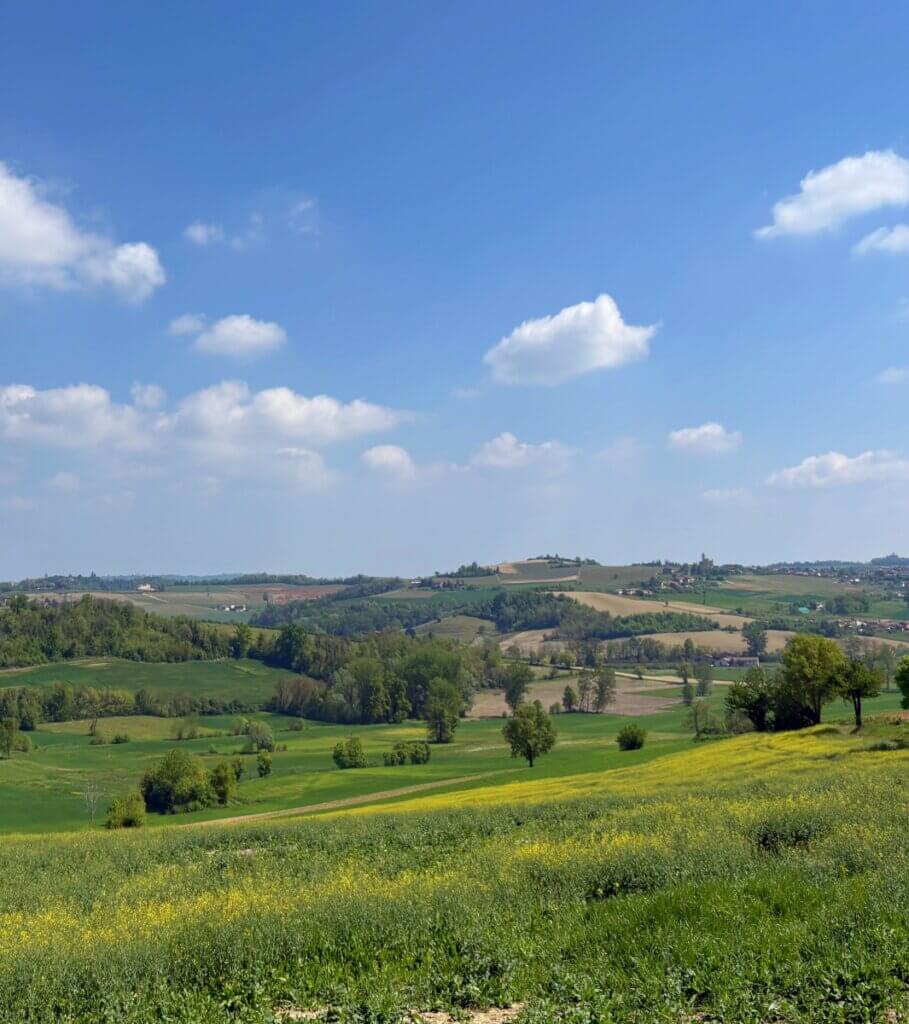
In that context, the experience of living part-time in Italy has been revealing, and also a kind of deeply emotional journey of connection with my ancestors. Today I was walking while looking at the landscape you see in the photo of this article: vineyards in the Piemonte region, in northern Italy, with very green hills in full spring, vineyards and fruit trees everywhere, like an endless field of peace. I collected many wildflowers, which are very common here; my friends and family know that I love flowers and their colors.
Beyond Residency: The True Purpose of the Expat
In the field of international immigration law, we often talk about rules, visas, and procedures. However, the real experience of a migrant – the one that does not appear in often tedious immigration laws – has to do with something much deeper: the sense of belonging, of discovering something new and trying to become part of it.
For years, I have supported people from many countries who decided to settle in Peru, sometimes for a few years, sometimes permanently. I have seen their adaptation processes, their successes, and their difficulties. But today I write from a different place.
Not only as a lawyer, but also as a migrant, sharing my personal experience and the impressions I perceive through our daily work.
Ikigai and the Migrant’s Paradox
The Japanese concept of Ikigai, popularized by Spanish authors Héctor García and Francesc Miralles in a book translated into more than 70 languages, speaks about purpose in life.
One of its key conclusions highlights a fundamental idea: life in community is essential for well-being. A sense of belonging gives meaning to everyday life and forms the core of living within a community.
And this is precisely where the migrant’s paradox appears.
When the Expert Becomes the Foreigner
For years, in Peru, I have been in a comfortable position:
I am the one who understands the system, the culture, and how things work.
I can guide a foreign client on where to live, which areas to choose, where to enjoy a good ceviche, how to bring their pet or container from their country of origin, or how to navigate the city.
In that context, one becomes – almost without realizing it – local reference.
But in Italy, everything changes.
Here in Piemonte, the reality is different. Here, I am the foreigner.
Despite having Italian roots and sharing a family history with this land, the everyday experience is clear: I am not part of the local society, and that is felt in the smallest details.
There is an Italian expression, especially in southern Italy, called dolce far niente, which means “the sweetness of doing nothing.”
It is not about laziness or lack of productivity. It is about enjoying the moment without guilt, like having an espresso, being present without the need to produce, finding pleasure in the pause—in other words, enjoying your own personal, intimate moment, even with a slightly self-indulgent connection to your inner self.
Returning to the Idea of Belonging
The process of connection and belonging also requires resilience: being flexible and kind to yourself. This mindset helps you avoid frustration with the small obstacles of daily life.
These are not major difficulties, but rather a series of constant small challenges: nuances of the language that are not fully mastered, implicit social codes, ways of making humor or telling a joke, traditions that are not fully understood, or even the fact that much of the day revolves around food.
Every conversation, every procedure, every daily interaction requires additional effort and leads to mental fatigue from language and understanding something new.
Discomfort as Learning
This experience has allowed me to understand, from the inside, something I had only observed from the outside before.
I often say a phrase I like: dare to “cross the bridge,” expressed metaphorically, when I see someone who is already integrated or on that path.
It is important to understand that migration involves a constant balance between identity and adaptation.
It is a feeling that is difficult to explain, but easy to recognize:
Being present, but not fully integrated.
Having roots, but not belonging.
Understanding, but not completely.
That bittersweet feeling we often cannot fully express, but we feel it. I am sure many expatriates will understand exactly what I mean.
The Real Importance of Integration
This is where Ikigai stops being a distant concept from a faraway culture and becomes a concrete necessity, because at its core, it is universal.
One begins to understand that true stability does not come from a visa, a residence permit, or a legal status. These are simply tools that provide security and legality, but they do not create social integration.
True stability comes from something much deeper: human relationships, connection with the environment, and participation in the community you are becoming part of.
A Personal Note for Expats in Peru
This experience in Italy has allowed me to re-evaluate the process of those who arrive in Peru, because now I know through lived experience that:
Learning the language is not optional.
Integration is not automatic; it requires daily effort.
Belonging takes time.
There is always the option to return to a place where you were not happy: buy a plane ticket, close some administrative matters, and leave.
But true migration success is not measured in documents, but in the ability to feel part of a place.
Peru and Italy: Two Sides of the Same Experience
In Peru, many expatriates live the opposite process: they arrive with enthusiasm but face cultural differences, relationships that are not what they expected, social barriers, and moments of disconnection.
Today, from Italy, I understand that process better and in a way, I share it.
Final Reflection
Immigration law opens doors, but it does not build homes.
Ikigai reminds us that life gains meaning through connection.
And that connection is not achieved with a visa. It is built over time, with openness and the willingness to belong.
Conclusion
Today, as a lawyer and as a migrant, I have a clearer conviction than ever: migration is not about changing countries… it is about learning how to live in another part of the world—and above all, within another culture.
And in that process, perhaps we also reconnect with ourselves. That is my best wish, because there is no perfect country or city.
Moments of happiness are created by us. Geography is only the background of the picture. What truly matters is within you.
Thinking about moving to Peru?
If you are considering living in Peru or have questions about your immigration process, we are here to help.
Although I am currently in Italy, our work in Lima continues seamlessly thanks to our local team and the digital tools that allow us to stay in direct contact with you.
You can schedule a consultation or send us your case by email to receive personalized guidance.

Need help choosing the right visa for Peru?
Immigration rules in Peru can be confusing – especially when it comes to the required documents, timelines, and legal steps. Choosing the right visa from the start can save you time, money, and stress.
Book your private consultation with Sergio Vargas to get expert guidance on the best visa option for your situation – and a clear plan to move forward.
The session takes place via Zoom and can be conducted in English or Spanish.
Don’t miss out on important updates!
Subscribe to our Substack newsletter and get the latest articles on immigration, taxes, and real estate in Peru delivered straight to your inbox.
Excelente y muy real reflexión!